Terms index
§ 05 · Term Glossary

Pluto

84Simple

Gematria values

§ 01
Standard systems6 methods
Standard21red. 3
Simple84red. 3
English504red. 9
Hebrew430red. 7
Satanic3024red. 9
ALW Kabbalah1060red. 7
Reverse systems6 methods
Standard24red. 6
Simple51red. 6
English306red. 9
Hebrew89red. 8
Satanic1836red. 9
ALW Kabbalah123red. 6

About Pluto

§ 02

Pluto (Hebrew: פְּלוּטוֹ, transliteration: *Pluto*; French: *Pluton*; German: *Pluto*; Spanish: *Plutón*) is a dwarf planet in the Kuiper belt, a ring of bodies beyond the orbit of Neptune. It was the first Kuiper belt object to be discovered and is the largest known dwarf planet in the Solar System. Pluto was discovered by Clyde Tombaugh in 1930 and was originally considered the ninth planet from the Sun. After 1992, its status as a planet was questioned following the discovery of several objects of similar size in the Kuiper belt. In 2005, Eris, a dwarf planet slightly more massive than Pluto, was discovered, which led the International Astronomical Union (IAU) to define the term "planet" formally in 2006. This definition excluded Pluto and reclassified it as a dwarf planet. Pluto has five known moons: Charon (the largest, with a diameter just over half that of Pluto), Styx, Nix, Kerberos, and Hydra. Pluto and Charon are sometimes considered a binary system because the barycenter of their orbits does not lie within either body.

Wikipedia Information

Pluto

Largest dwarf planet
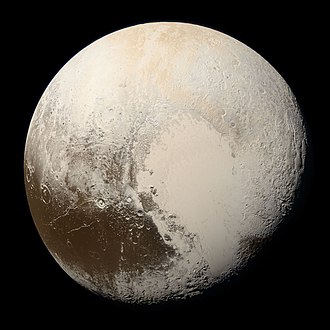
Pluto

Pluto is a dwarf planet in the Kuiper belt, a ring of bodies beyond the orbit of Neptune. It is the ninth-largest and tenth-most-massive known object to directly orbit the Sun. It is the largest known trans-Neptunian object by volume by a small margin, but is less massive than Eris. Like other Kuiper belt objects, Pluto is made primarily of ice and rock and is much smaller than the inner planets. Pluto has roughly one-sixth the mass of the Moon and one-third of its volume. Originally considered a planet, its status was changed when astronomers adopted a new definition of the word with new criteria.

Last modified 2025-11-19T06:24:02ZView full article